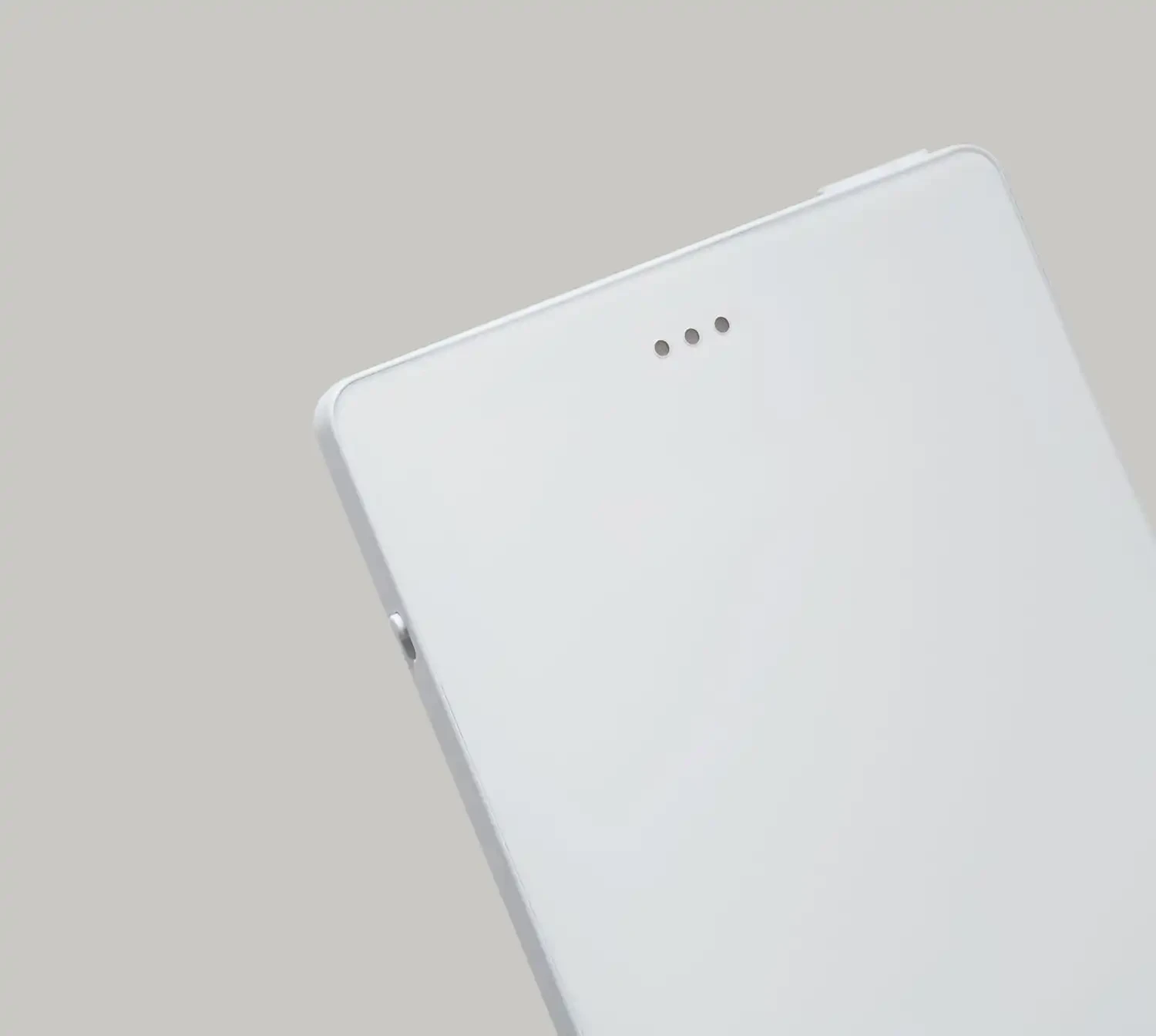
Ultra thin and light product design
Industrial design, 3D structure and internal layout are developed together, so a thin reading device still feels rigid in the hand and holds up in daily use.
Why this is hard today
Thinness competes with battery capacity, rigidity and assembly yield. Every millimetre removed tightens the tolerance chain between panel, frame, battery and board, and a design that looks thin on paper can flex, creak or fail a drop test in the hand.
Our ID/MD Design
- 01
Form factor and weight budget
Target thickness, weight, grip width and bezel are fixed before parts are released. Materials are chosen for stiffness per gram, and the battery volume is reserved first instead of being filled with leftovers.
- 02
3D structure and stack-up
A magnesium or reinforced mid-frame carries the stiffness. Wall thickness, rib layout and screw bosses are modelled in 3D, and the tolerance chain across panel, light guide, battery and mainboard is calculated so parts fit without preload.
- 03
Internal layout and assembly
The board shape, connector positions and shielding are arranged around the display bonding line. Assembly order, fixture access and serviceability are reviewed at the same time, so thinness does not turn into a yield problem on the line.
- 04
Validation of thin structures
Prototypes go through torsion, pressure, drop and dust tests. When a weak point appears, ribs, adhesive and material are adjusted rather than adding thickness back, and the final stack-up is verified against the original weight budget.
Scope a pilot for this solution
Share the line, systems and target metric. We will reply with a pilot plan.